01
Read-only by design
TraceForge never launches, attaches to, or modifies the target. Every read is bounded before allocation.
 TraceForge
A read-only binary inspector for Mach-O, ELF, PE and WebAssembly. Deterministic records, a local authenticated store, and an MCP server your agents can trust.
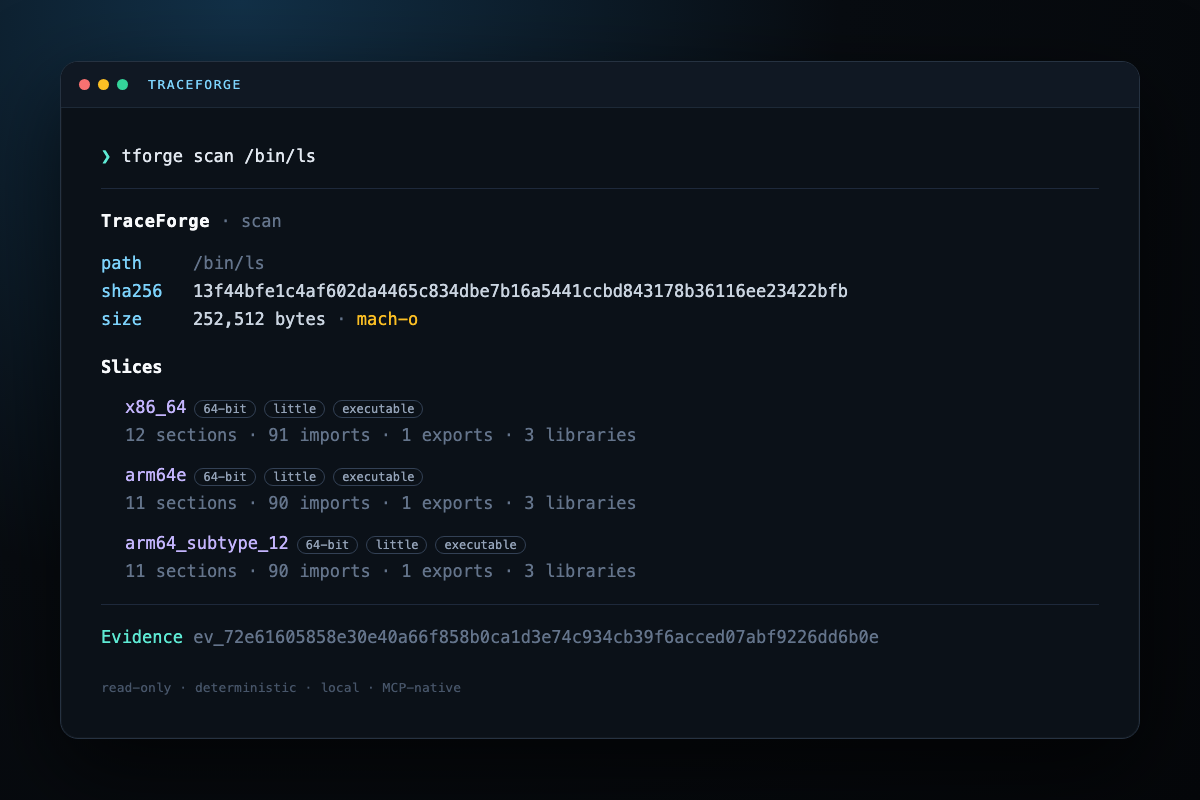
No execution. No telemetry. No mystery state. Just bounded parsing and records you can verify.
TraceForge never launches, attaches to, or modifies the target. Every read is bounded before allocation.
Each result gets a content-addressed ID, input SHA-256, limitations and a local JSON record.
A dependency-free MCP stdio server exposes the same core as the CLI. Six tools, one Evidence contract.
Inspect every slice or select one architecture with --arch arm64.
Compare sections, imports, exports and slice metadata without host-specific noise.
The runtime uses Node built-ins only. The MCP protocol is implemented directly.
Node 22 or newer. No accounts, no API keys, no background daemon.
Need a portable record? evidence export writes a deterministic bundle; evidence import authenticates every record before merging.
Identity badge, sections, symbols and limitations — one standalone HTML file, no external scripts.
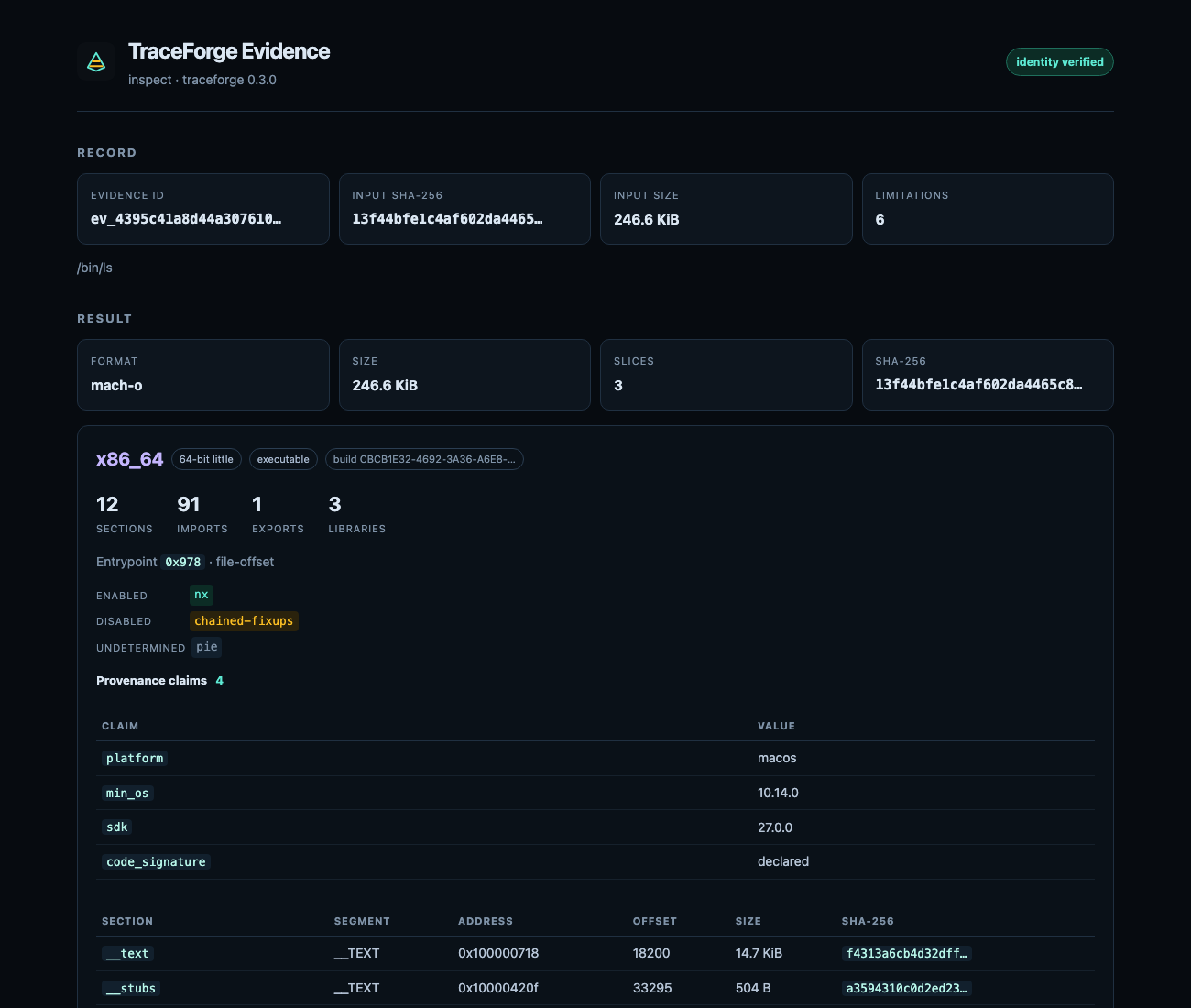
tforge report /bin/ls --out report.html
Not mockups. scripts/gallery.mjs builds four synthetic demo packages under one fixed, username-free path (/tmp/traceforge-gallery), and each page below was written by tforge report against them, then committed unchanged. Rerun the script on any machine and every byte — and every Evidence ID — comes back identical. Open one: it is a standalone page that fetches nothing and runs nothing.
18 files, 5.1 KiB — and an app that contains other apps. The report lists 5 nested packages: DemoFramework.framework (its classic version tree leaves five aliases recorded, never followed), its inner Updater.app, and two .xpc services, each labelled with the identifier its own manifest declares.
One member is 8,388,608 bytes — 8.00 MiB — hashed in a single pass, and the whole report is still 9,997 bytes. Its Limitations box says plainly that app.asar, assets.zip and cache.car were counted and hashed but not opened.
A 5,007-member tree is bigger than the inventory budget, so the walk stopped and said so: “The walk stopped at the 5,000 member limit; later members are absent from the inventory and from the tree fingerprint.” Exactly 5,000 members were recorded — 1 Mach-O, 4,999 unknown format — and the stop sits in the report's Limitations box.
/tmp/traceforge-gallery/Demo İstemci.app is only an alias, and its name carries a dotted capital İ; inside, the walk reaches İçeriler/çalışma-günlüğü.txt. TraceForge inventoried what the alias points to — 10 files across 12 directories — recorded the path you gave, and never followed the 5 links inside. The outer bundle and a nested one declare the same identifier.
The script builds its own demo targets from fixed bytes, then only calls the CLI — it renders no HTML of its own — rejects any report over its size cap, audits every tag before keeping the file, and --check re-runs the whole set and byte-compares it. Full gallery notes.
One honest note: inside a report, the member tables are wider than a phone screen, so they scroll sideways inside their own wrapper — nothing overflows a box any more, and long paths and hashes break where they must. The record is complete; only the layout is the limit.
One stdio server. Six tools. No SDK or cloud relay in the middle.
scan_binary — format, hashes and slice summary.inspect_binary — sections, symbols, libraries; optional architecture.inspect_package — a whole .app or directory, the thing behind the gallery reports.compare_binaries — deterministic structural changes.get_evidence / list_evidence — authenticated local records.The server speaks newline-delimited JSON-RPC 2.0 over stdio and never writes non-protocol data to stdout.